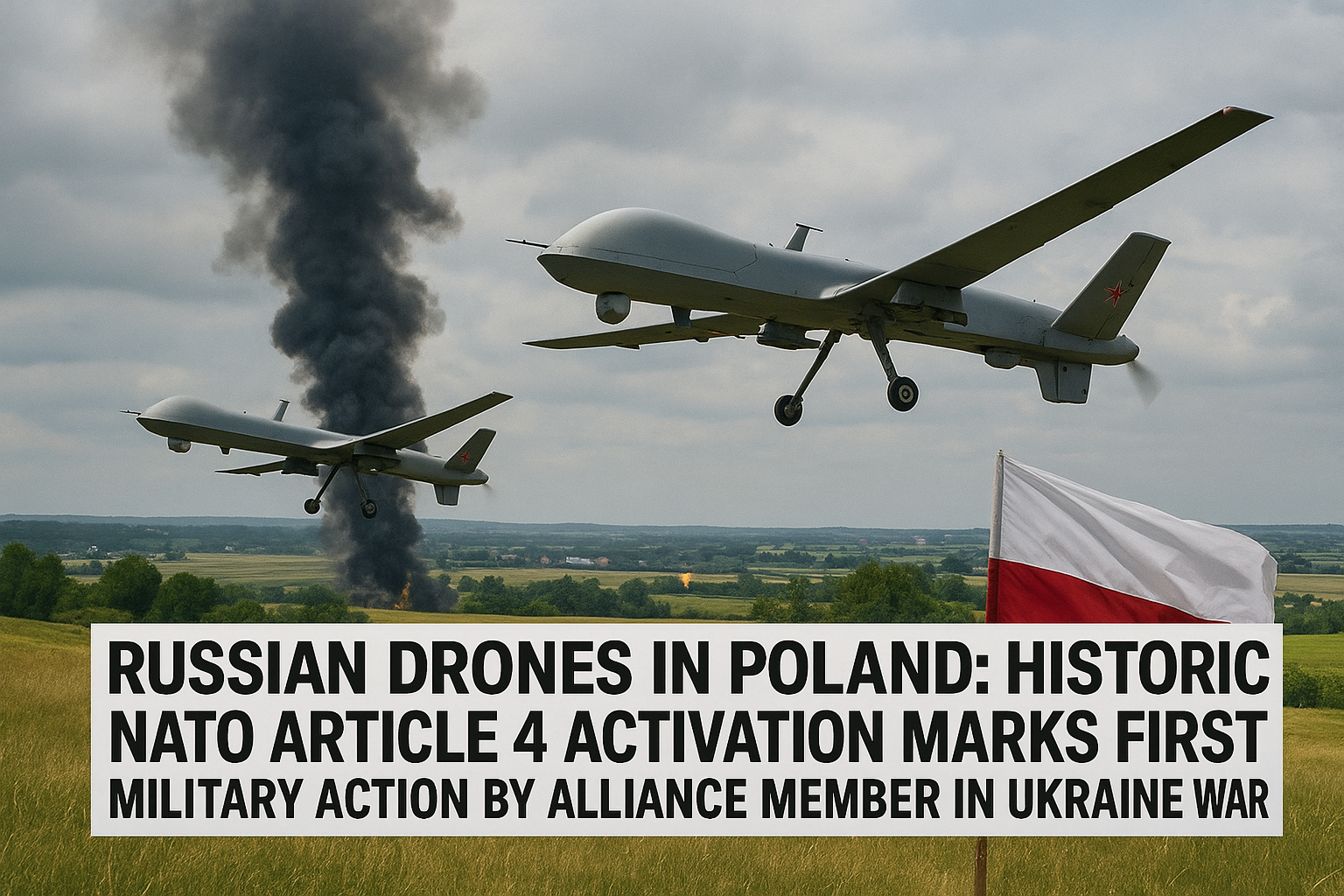
Two Russian military drones spotted over Polish territory as NATO activates Article 4 for the first time in the Ukraine war, marking a historic moment of collective defense consultation.
Poland Shoots Down Russian Drones in Historic First
On September 10, 2025, Poland made history by becoming the first NATO member state to engage Russian military assets directly during the Ukraine war, shooting down multiple Russian drones that violated its airspace. The incident prompted Poland to invoke NATO’s Article 4, calling for urgent consultations with allies after what Prime Minister Donald Tusk described as the “closest” Europe has been to “open conflict since World War Two”.
The unprecedented event unfolded overnight between September 9-10, 2025, when at least 19 Russian drones entered Polish airspace during a massive aerial assault on Ukraine involving approximately 415 drones and over 40 missiles across 15 Ukrainian regions. Polish and NATO forces, including Dutch F-35 fighter jets, Italian AWACS surveillance aircraft, and NATO-operated mid-air refueling planes, successfully intercepted multiple drones that posed “a direct threat” to Polish security.
Timeline of the September 10 Incident
The airspace violations began at approximately 11:30 PM CEST on Tuesday, September 9, with the last violation recorded at 6:30 AM CEST on Wednesday morning. Polish authorities tracked 19 separate incursions, with up to four drones confirmed shot down by Polish and allied forces. The final drone was eliminated at 06:45 CEST.
During the crisis, Poland temporarily closed four major airports, including Warsaw’s Chopin Airport, Rzeszów–Jasionka Airport, Warsaw Modlin Airport, and Lublin Airport. The closures were attributed to “unplanned military activity related to ensuring state security”.
Article 4 Invocation: Only the Eighth Time in NATO History
Prime Minister Donald Tusk confirmed that Poland formally requested the activation of Article 4 of the North Atlantic Treaty, marking only the eighth invocation in NATO’s 76-year history. Article 4 allows any member state to call for consultations when it feels its “territorial integrity, political independence or security” is threatened.
Unlike Article 5, which mandates collective defense and has been used only once (after 9/11), Article 4 serves as a consultation mechanism that may or may not lead to military action. Previous invocations include Turkey’s requests during Middle Eastern conflicts and Eastern European nations’ concerns following Russia’s 2014 Crimea annexation and 2022 Ukraine invasion.
International Reactions and Analysis
Ukrainian President Volodymyr Zelenskyy characterized the incident as “an extremely dangerous precedent for Europe,” emphasizing that it was “not just one ‘shahed’ that could be called an accident, but at least eight strike drones aimed toward Poland”. Zelenskyy stressed that Russia must “feel the consequences” and understand “that the war cannot be expanded”.
US Representative Joe Wilson labeled the drone incursion “an act of war,” stating: “Russia is attacking NATO ally Poland with Iranian Shahed drones… This is an act of war, and we are grateful to NATO allies for their swift response to war criminal Putin’s continued unprovoked aggression”.
European Union foreign policy chief Kaja Kallas described the violation as “the most serious European airspace violation by Russia since the war began,” with early indications suggesting it was “intentional, not accidental”. EU President Ursula von der Leyen expressed “full solidarity with Poland”.
Physical Impact and Debris Recovery
One Russian drone struck a residential building in the village of Wyryki-Kolonia in Lublin Voivodeship, causing property damage but no injuries. Local mayor Bernard Blaszczuk confirmed that while people were inside the building when it was hit, no casualties occurred.
Polish authorities initiated extensive search operations for crash sites and debris, warning civilians not to approach any found objects due to potential hazardous materials. Drone debris was confirmed in multiple locations across eastern Poland, particularly near the Ukrainian and Belarusian borders.
Russian Response and Denials
Russia categorically denied involvement in the incident. Andrei Ordash, Russia’s chargé d’affaires in Poland, dismissed the accusations as “groundless,” claiming Poland had provided no proof that the downed drones were of Russian origin. The Kremlin’s spokesperson Dmitry Peskov refused to comment on the incident, directing all inquiries to Russia’s Defense Ministry.
Context: Rising Tensions and Military Exercises
The drone incident occurred amid escalating tensions in the region, coinciding with Russia and Belarus conducting large-scale “Zapad-2025” military exercises near NATO’s eastern border. Poland responded by closing its border with Belarus at midnight on September 11, citing security concerns over the “very aggressive” military maneuvers involving up to 13,000 troops.
The exercises included drills simulating nuclear weapon deployment and testing of Russia’s intermediate-range hypersonic Oreshnik missile. NATO member states Poland, Lithuania, and Latvia expressed alarm over the exercises, with Lithuania also reinforcing security along its borders with Belarus and Russia.
Historical Context: Previous Incidents
This marks the most serious escalation since a stray Ukrainian air defense missile killed two people in Poland in November 2022. However, unlike that accidental incident, the September 2025 violations were characterized by officials as deliberate and systematic.
The incident follows a pattern of Russian aerial assets straying into NATO airspace throughout the Ukraine conflict, but previous violations had not resulted in direct military engagement. Poland’s Defense Minister noted that Russia has never admitted responsibility for similar incidents in Moldova, Romania, Lithuania, Latvia, and Bulgaria.
NATO’s Response and Future Implications
NATO Secretary-General Mark Rutte maintained close communication with Polish authorities throughout the crisis. The alliance confirmed it did not view the incident as an attack but rather as a deliberate incursion requiring consultation.
The incident fundamentally “changes the political situation,” according to Tusk, who emphasized that Poland expects “significantly greater support” in defending its airspace during the Article 4 consultations. He declared the situation a confrontation that “Russia has declared against the entire free world”.
Polish President Karol Nawrocki, speaking just days before the incident, had warned that Vladimir Putin was “ready to invade other countries” following his decision to attack Ukraine, necessitating enhanced military preparedness and allied cooperation.
Fact-Check Summary
Verified Facts:
- 19 Russian drones violated Polish airspace between 11:30 PM September 9 and 6:30 AM September 10, 2025
- Poland shot down multiple drones with NATO assistance, marking the first direct engagement by a NATO member in the Ukraine war
- Article 4 was formally invoked – the eighth time in NATO history
- One drone struck a residential building in Wyryki-Kolonia with no casualties
- Major airports were temporarily closed during the crisis
Official Sources:
- Polish Prime Minister Donald Tusk confirmed all major details
- NATO Secretary-General Mark Rutte acknowledged consultations
- Ukrainian President Zelenskyy confirmed at least 8 drones targeted Poland
- Multiple government sources from Poland, NATO allies, and EU officials corroborated the incident
The September 10, 2025 drone incident represents a watershed moment in the Ukraine conflict, marking the first time a NATO member has directly engaged Russian military assets and demonstrating the war’s potential for dangerous escalation beyond Ukraine’s borders.
About the Author


So many things happening 😨
something big is coming maybe